Spotlighting two iconic movie monologues, and what they offer on the human condition
The monologue is a long speech delivered by a character, directed towards other characters. An effective monologue moves further than the limits of the audience’s ears. It travels further still, breaching the mind and the heart in order to stir something deeper in the soul.
This has certainly been my experience with the following monologues, taken from Ridley Scott’s Kingdom of Heaven (2005) Director’s Cut, and Luca Guadagnino’s Call Me By Your Name (2017). While these films could not be more different on their surface, the connection between them emerges within their monologues. The two monologues I have selected are perhaps the most memorable in each film, each inciting the soul towards undertaking two separate journeys: the journey of the self, and the journey of the heart.
King Baldwin IV and the Journey of the Self:
Scott’s Kingdom of Heaven (2005) is an epic historical drama exploring the Crusades of the 12th century. The film’s first act follows the heavily fictionalised Balian of Ibelin (Orlando Bloom) to Jerusalem, having been recruited as a Crusader Knight by his father, Baron Godfrey (Liam Neeson). It is there that he meets King Baldwin IV (Edward Norton), the mysterious and stoic king of Jerusalem. Balian’s first encounter with Baldwin IV is perhaps one of the most memorable scenes in this film. The scene is dimly lit and eerily quiet, achieving a captivating quality as both Balian and the audience are made to face Baldwin’s powerful presence, his image and words both permeating through the screen. It is during this scene that Norton delivers this haunting monologue:
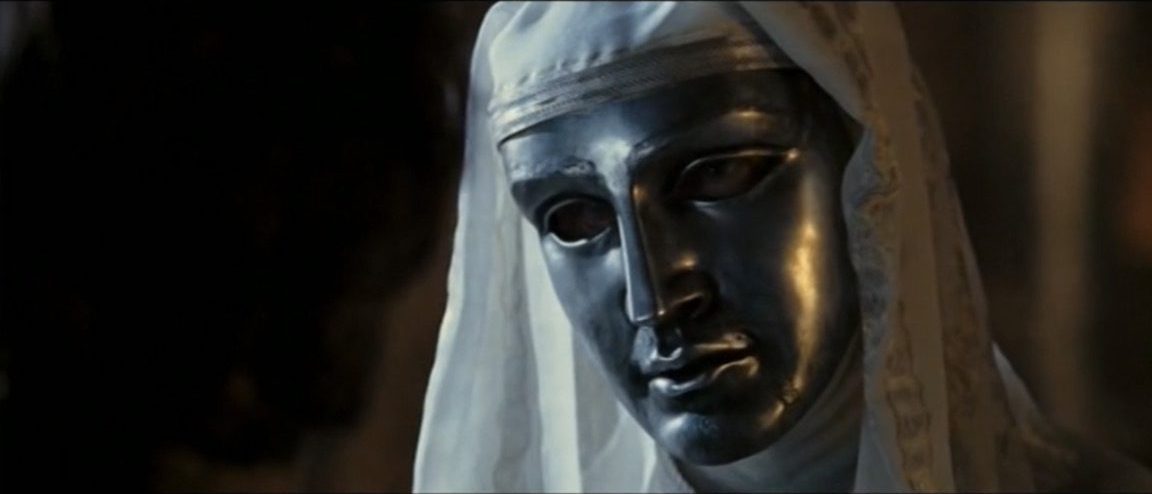
‘When I was sixteen, I won a great victory. I felt in that moment I would live to be a hundred. Now I know I shall not see thirty. None of us know our end, really, or what hand will guide us there. A king may move a man, a father may claim a son, but that man can also move himself, and only then does that man truly begin his own game. Remember that howsoever you are played or by whom, your soul is in your keeping alone, even though those who presume to play you be kings or men of power. When you stand before God, you cannot say, “But I was told by others to do thus,” or that virtue was not convenient at the time. This will not suffice. Remember that.’
At the beginning of this monologue, Baldwin describes his victory over the Ayubbid Sultan Saladin at the Battle of Montgisard in 1177, in which he defended the kingdom from Muslim conquest at just 16 years old. His reflection upon death is markedly poignant. Though we may acknowledge death’s inevitability, no one can claim to know when or how it shall present itself to us. For an ambitious and resilient young Baldwin, his consciousness of death’s approach came in the form of being diagnosed with leprosy.
Though death may seem inherently oppressive upon one’s life, Baldwin reveals how having an awareness of it may instead become a liberating force. An awareness of death can lead one to truly embark on the journey of the self through forcing us to become intentional within our lives. Though others may intrusively impose their plans upon us, be it family, society or other authoritative powers, Baldwin reminds us that at the end of life, when one is faced with death, they are left with no one but themselves, forced to confront their own actions. He positions this not merely as a sentimental thought – rather, he argues it should be our lives priority to ask ourselves every day what our duty to ourselves truly is, and aim to live every day seeking to fulfil this vision.
Mr. Perlman and the Journey of the Heart:
The second monologue focuses on a different kind of duty to oneself, featured in Guadagnino’s Call Me By Your Name (2017). At this point in the film, set in the sublime backdrop of 1980s Northern Italy, a devastated Elio (Timothée Chalamet) deals with the emotional turmoil of having said his final goodbyes to Oliver (Armie Hammer). This follows a seemingly endless summer, in which Elio slowly comes to terms with his budding feelings towards Oliver, eventually entering into a secret relationship with him. This relationship, however, is cut short by Oliver’s return to the US, leaving Elio, who allowed himself to become vulnerable enough to act on his feelings towards Oliver, almost in a state of emotional paralysis, reflected by the cool palette signalling endings: the end of the summer, and the end of Elio’s experience of love. Elio’s father, Mr. Perlman (Michael Stuhlbarg) has come to understand the nature of their relationship. Sensing that Elio may be trying to shut himself off from his feelings, he offers his son these words on the value of love:
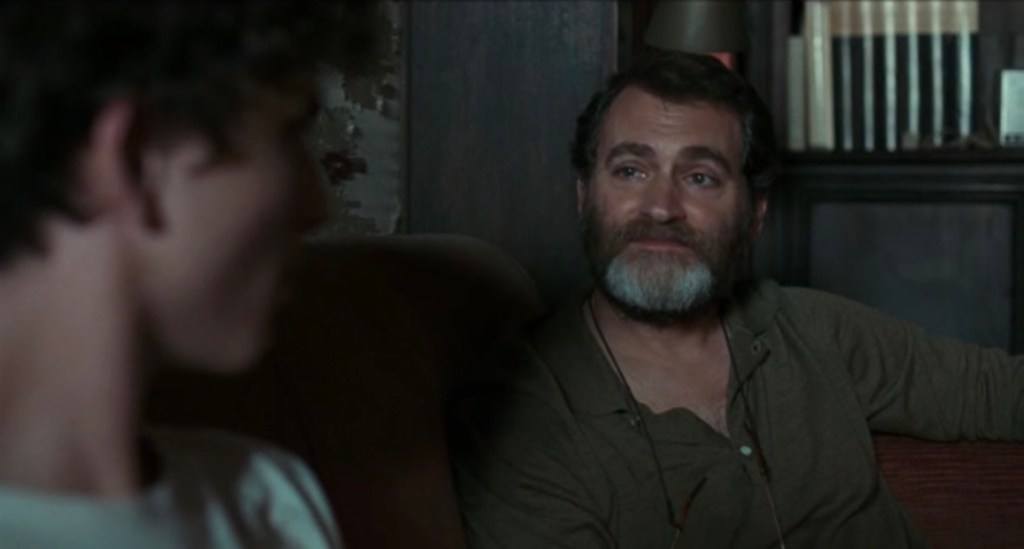
‘Nature has cunning ways of finding our weakest spot. Just… Remember I’m here. Right now you maybe don’t wanna feel anything… Maybe you’ll never want to feel anything. And maybe it’s not to me you wanna speak about these things but… Feel something you obviously did. […] We rip out so much of ourselves to be cured of things faster, that we go bankrupt by the age of thirty and have less to offer each time we start with someone new. But to make yourself feel nothing so as not to feel anything – what a waste! […] I may have come close, but I never had what you two have. Something always held me back or stood in the way. How you live your life is your business. Just remember, our hearts and our bodies are given to us only once. And before you know it, your heart is worn out, and, as for your body, there comes a point when no one looks at it, much less wants to come near it. Right now there’s sorrow. Pain. Don’t kill it and with it the joy you’ve felt.’
Here, Perlman identifies a common mistreatment of pain. In wanting to be rid of pain, we may neutralise emotions entirely, as a retaliation against vulnerability. Elio becoming vulnerable was fundamental to beginning his experience of falling in love, and later becomes the source of his pain. It is the latter experience that leads so often to vulnerability being perceived as a weakness, as something that should actively be resisted. However, Perlman emphasises here the necessity of vulnerability to one’s capacity to love, and be loved.
In undertaking the experience of love, be it platonic or romantic, one must accept both the joy and pain that is inherent to the journey of the heart. To experience love wholly is to accept its liberating moments, as well as its oppressive ones. And only by accepting this dual nature of love are we able to deliver it wholly to others in return. The film, and this scene in particular, asks us to consider if it is better to experience love, and inevitably experience the pain that comes with it, or to not experience love at all. It asks if it is better to allow ourselves to become vulnerable to our feelings, whether they be positive or negative, or to not feel at all. At its core, it asks the question Elio’s mother (Amira Casar) poses directly: if it is better to speak, or to die.


Leave a comment